




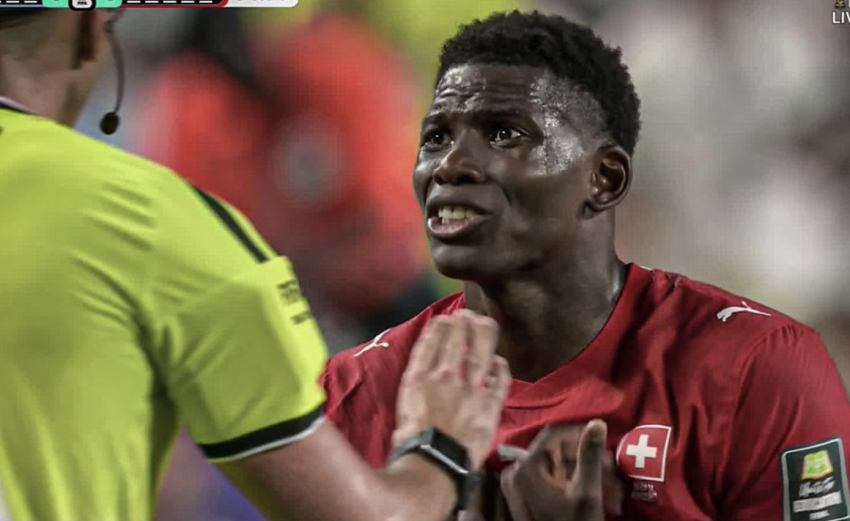
Breel Embolo’s red card during Switzerland’s 2026 FIFA World Cup quarterfinal against Argentina quickly became one of the tournament’s most talked-about moments.
The Swiss striker was sent off in the second half after receiving a second yellow card following a VAR review, leaving Switzerland to finish the match with 10 players in a dramatic and controversial decision.
Why was Breel Embolo sent off against Argentina?
Embolo was shown a red card in the 72nd minute after the referee determined he had simulated contact while attempting to win a free kick near Argentina’s penalty area.
Initially, the referee believed Argentina midfielder Leandro Paredes had committed a foul and showed Paredes a yellow card. However, the Video Assistant Referee (VAR) recommended an on-field review.
After watching the replay, the referee overturned the original decision, concluding that Paredes had not fouled Embolo and that the Swiss forward had instead attempted to deceive the official by exaggerating or initiating the contact.
Because Embolo had already received a yellow card earlier in the match, the second caution automatically resulted in a red card, forcing Switzerland to play the remainder of the quarterfinal with 10 men.
Why was VAR allowed to review the incident?
The review was possible because of FIFA’s updated VAR protocol introduced for the 2026 FIFA World Cup.
The expanded protocol allows VAR to intervene in certain mistaken identity situations involving yellow cards that could directly lead to a player’s dismissal. In this case, the review determined that the initial booking should not have gone to Paredes.
After the review:
- Leandro Paredes’ yellow card was rescinded.
- Breel Embolo was shown a yellow card for simulation.
- Since it was Embolo’s second booking of the match, he was sent off.
The sequence became one of the first major examples of the tournament’s updated VAR procedures being used to change the outcome of a disciplinary decision.
Why is the decision controversial?
The dismissal sparked immediate debate among players, fans, and television commentators.
Many believed there was enough contact to justify a foul, while others agreed with the referee that Embolo had attempted to win a free kick through simulation.
Swiss players surrounded the referee following the decision, and Embolo left the field visibly emotional after being shown the red card.
Given the magnitude of the match—a World Cup quarterfinal—the incident is likely to remain one of the defining refereeing moments of the 2026 tournament.
What does simulation mean in soccer?
Simulation, commonly referred to as diving, occurs when a player attempts to deceive the referee by pretending to have been fouled or exaggerating contact in order to win a free kick or penalty.
Under the IFAB Laws of the Game, simulation is considered unsporting behavior and is punishable by a yellow card.
If a player who has already been cautioned receives another yellow card for simulation, it results in a second yellow card followed by a red card.
Breel Embolo red card vs Argentina
Breel Embolo’s dismissal against Argentina will be remembered as one of the most controversial VAR decisions of the 2026 FIFA World Cup. What began as a yellow card for Leandro Paredes ended with Embolo receiving a second booking for simulation after video review, reducing Switzerland to 10 men during one of the biggest matches of the tournament.
As FIFA’s expanded VAR rules continue to be implemented, the incident is likely to be cited as a landmark example of how technology can dramatically alter the course of a World Cup match.