




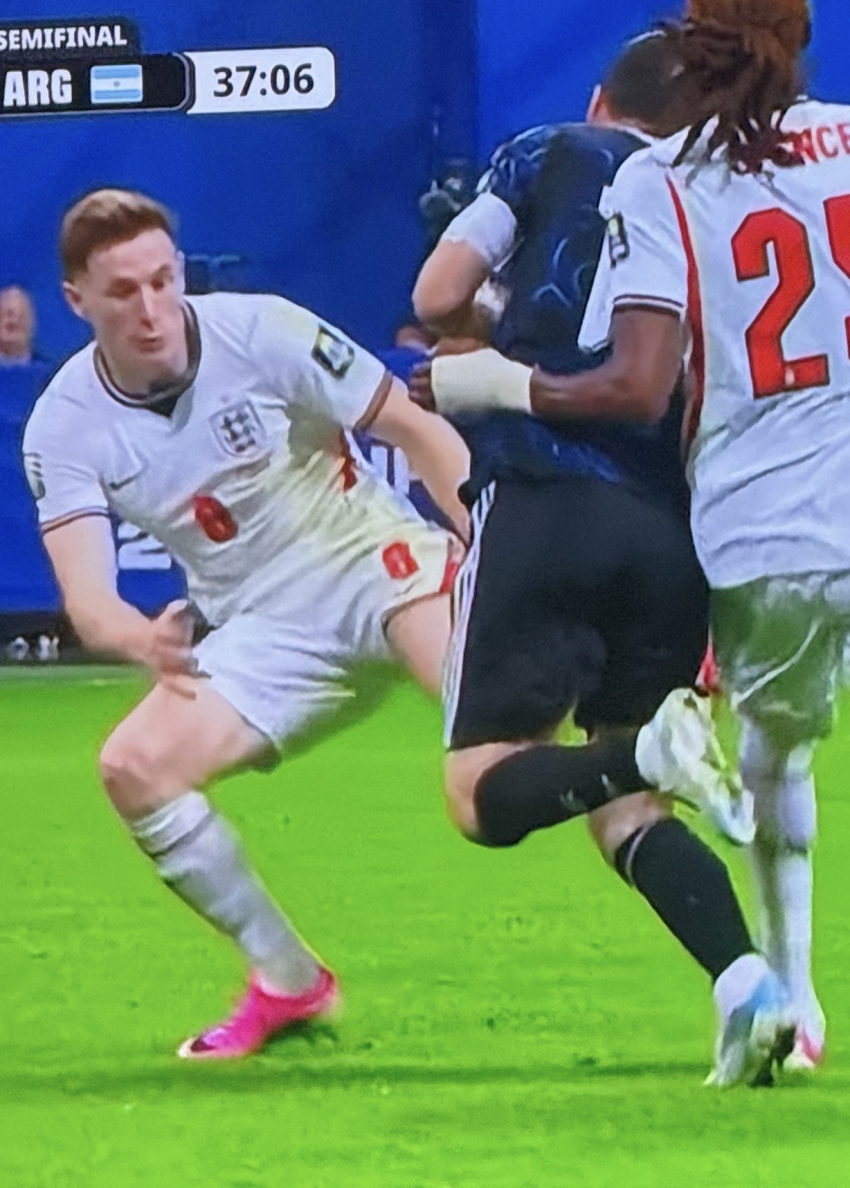
England midfielder Elliot Anderson found himself in the spotlight after receiving a yellow card for a hard challenge on Lionel Messi during the first half of England’s 2026 FIFA World Cup semifinal against Argentina.
The tackle immediately sparked debate among fans and commentators, with many wondering why the challenge resulted in only a yellow card instead of a sending-off. Ultimately, the referee determined that Anderson’s foul met the standard for a caution but not for a red card under the Laws of the Game.
What Happened?
The incident occurred during a highly competitive first half as England and Argentina battled for a place in the 2026 FIFA World Cup Final.
Messi was carrying the ball through midfield when Anderson stepped in with a forceful tackle that brought the Argentine captain to the ground. Play was immediately stopped, and the referee issued Anderson a yellow card after judging the challenge to be reckless.
The booking was one of several disciplinary decisions in an intense semifinal between two nations with one of football’s greatest rivalries.
Why Was Elliot Anderson Given a Yellow Card?
According to the IFAB Laws of the Game, a player is shown a yellow card when committing a reckless challenge.
A reckless tackle occurs when a player:
- Acts with disregard for the danger to an opponent.
- Makes a mistimed or overly forceful challenge while attempting to play the ball.
- Commits a foul that deserves a caution but does not endanger an opponent’s safety to the highest degree.
The referee ruled that Anderson was attempting to win possession and did not use excessive force, making a yellow card the appropriate disciplinary action.
Why Wasn’t It a Red Card?
Many supporters questioned whether the tackle should have resulted in a dismissal.
For a red card to be issued, the referee must determine that the challenge involved:
- Serious foul play.
- Excessive force.
- A tackle that endangered the safety of an opponent.
- Violent conduct.
After reviewing the incident in real time, the referee concluded that Anderson’s challenge, while hard, did not reach the threshold required for a straight red card.
VAR also did not recommend an on-field review, indicating there was no clear and obvious error in the referee’s original decision.
A Physical England vs Argentina Semifinal
The semifinal was played at an extremely high intensity from the opening whistle.
Both teams committed numerous fouls as they battled for control of midfield, and the referee was forced to manage several heated moments throughout the match.
Anderson’s booking set the tone for what became one of the tournament’s most physical knockout matches, with neither side willing to give an inch as a place in the World Cup Final was on the line.
What the Laws of the Game Say
The distinction between a yellow and red card often comes down to the level of force used during a challenge.
Yellow Card
- Reckless tackle.
- Attempt to play the ball.
- Disregard for an opponent without excessive force.
Red Card
- Serious foul play.
- Excessive force.
- Challenge that endangers an opponent’s safety.
- Violent conduct.
Because Anderson’s tackle was judged to be reckless rather than excessively dangerous, the referee issued a caution instead of sending the England midfielder off.
Final Thoughts
Elliot Anderson’s challenge on Lionel Messi became one of the biggest talking points of England’s 2026 FIFA World Cup semifinal against Argentina.
Although the tackle was forceful and halted one of football’s greatest players, the referee determined it was a reckless attempt to win the ball rather than an act of serious foul play. As a result, Anderson received a yellow card, allowing England to continue the match with 11 players.
The decision highlighted the fine line officials must draw between physical but fair challenges and tackles that warrant a dismissal, particularly in high-pressure World Cup knockout matches where every decision can influence the outcome.