





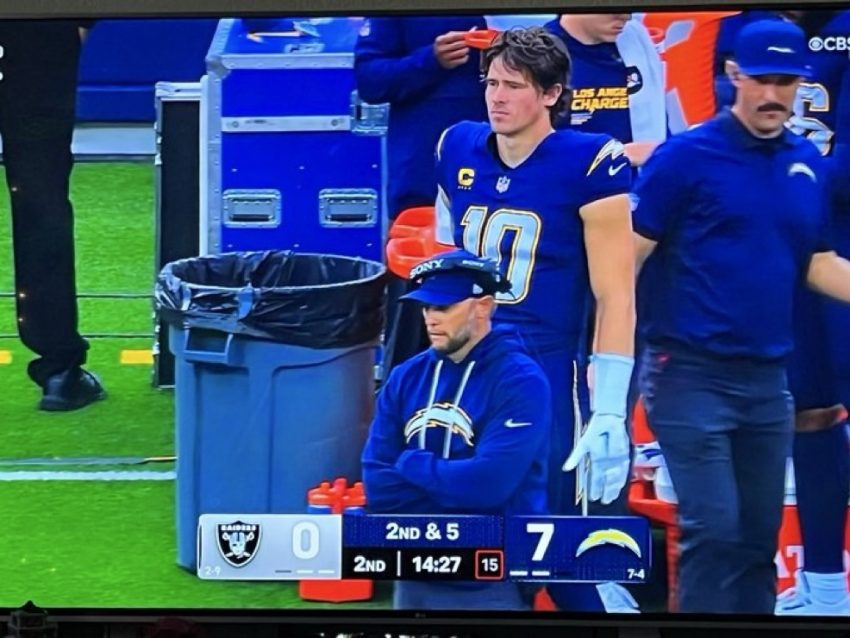
Justin Herbert’s left hand injury goes beyond simple discomfort—it could fundamentally affect how the Los Angeles Chargers execute their offense, especially against elite pass-rushing defenses. While Herbert throws with his right hand, the left hand plays a critical role in ball handling, stability, snap control, protection against strip sacks, and overall pocket mechanics. With tough matchups ahead, even a minor limitation can become a major obstacle.
Why Herbert’s Left Hand Matters More Than People Think
Quarterbacks rely on their non-throwing hand far more than fans realize. It’s essential for:
- Taking snaps under center — A left hand injury may force the Chargers to abandon traditional under-center formations, limiting play-action and quick-hitting run schemes.
- Ball security — The left hand helps secure the ball when scrambling, faking, or absorbing hits. Injuries increase turnover risk, especially against aggressive defenses.
- Pump fakes and rollouts — Stabilizing the ball requires both hands. Without full grip control, Herbert may lose accuracy or be unable to execute complex passing mechanics.
- Protecting against strip sacks — When pressure comes from Herbert’s blind side, his left hand is critical to keeping possession when hit.
Likely Offensive Adjustments
We saw Aaron Rodgers recently play with a wrist injury, where he remained exclusively in pistol and shotgun formation to avoid snap pressure. Herbert may face a similar shift, which can:
- Reduce play-action effectiveness
- Limit power running plays
- Make the offense more predictable
- Increase pass attempts against strong defensive fronts
This significantly affects game planning — especially against defenses like the Eagles, Cowboys, Broncos, Texans, and Chiefs, all of whom feature strong edge rushers.
Why This Injury Is Risky Against Upcoming Defenses
The Chargers do not face a single opponent under .500 for the rest of the season. These defenses are built to exploit exactly this type of vulnerability:
| Opponent | Defensive Strength | Risk to Herbert |
|---|---|---|
| Eagles | Elite pass rush featuring Haason Reddick | Strip sack threat, collapsing pocket |
| Chiefs | Top-5 scoring defense | Tight coverage + high pressure |
| Cowboys | Fast edge defenders, high turnover rate | Ball security risk |
| Texans | Schematically aggressive defense | Forced outside pocket movements |
| Broncos | Opportunistic pass defense | Heavy blitz schemes late in games |
Against these teams, pocket stability and snap consistency will be crucial—and Herbert’s left hand is directly involved in both.
How It Affects Herbert’s In-Game Decision Making
- Quicker release — Herbert may be forced into shorter throws to avoid contact.
- Less scrambling — Without secure ball control, Herbert may hesitate to run or extend plays.
- Fewer play-action fakes — With snap challenges, the Chargers may abandon under-center play-action.
- Increased shotgun usage — This limits offensive unpredictability and timing routes.
Playoff Impact: Could the Chargers Fall Out?
Currently sitting at 8–4 and holding a Wild Card spot, the Chargers are far from secure. The Texans and Chiefs—both on the schedule—could leapfrog them in the standings. If Herbert struggles with grip control, play design, or ball protection under pressure, even one or two losses could eliminate them from playoff contention.
Final Outlook
Justin Herbert’s left hand injury is not just a medical concern—it’s a tactical concern. It affects snap handling, formation flexibility, ball security, and decision-making, especially against elite pass rushes. With a dangerous schedule ahead, his ability to manage this injury may determine whether the Chargers stay in the playoff race—or slide out of it.