





The NFL has prevailed in a high-profile grievance against the NFL Players Association (NFLPA), resulting in an arbitrator’s ruling that bars the union from publicly releasing its annual “Team Report Cards.” The decision marks a significant development in ongoing labor relations between the league and the players’ union.
The dispute, originally filed in August 2025, centered on the NFLPA’s practice of grading franchises on facilities, player treatment, travel conditions, and ownership — based on anonymous player surveys. According to reporting from Adam Schefter, the ruling confirms the league’s position that the unilateral surveys violated provisions of the Collective Bargaining Agreement (CBA).
Why the NFL Filed the Grievance
The NFL argued that the NFLPA’s independently conducted surveys failed to meet the CBA’s requirement for jointly conducted scientific research when evaluating club operations. League officials contended that the union’s methodology lacked transparency and fairness, and that the results were presented in a way that advanced union interests rather than providing neutral analysis.
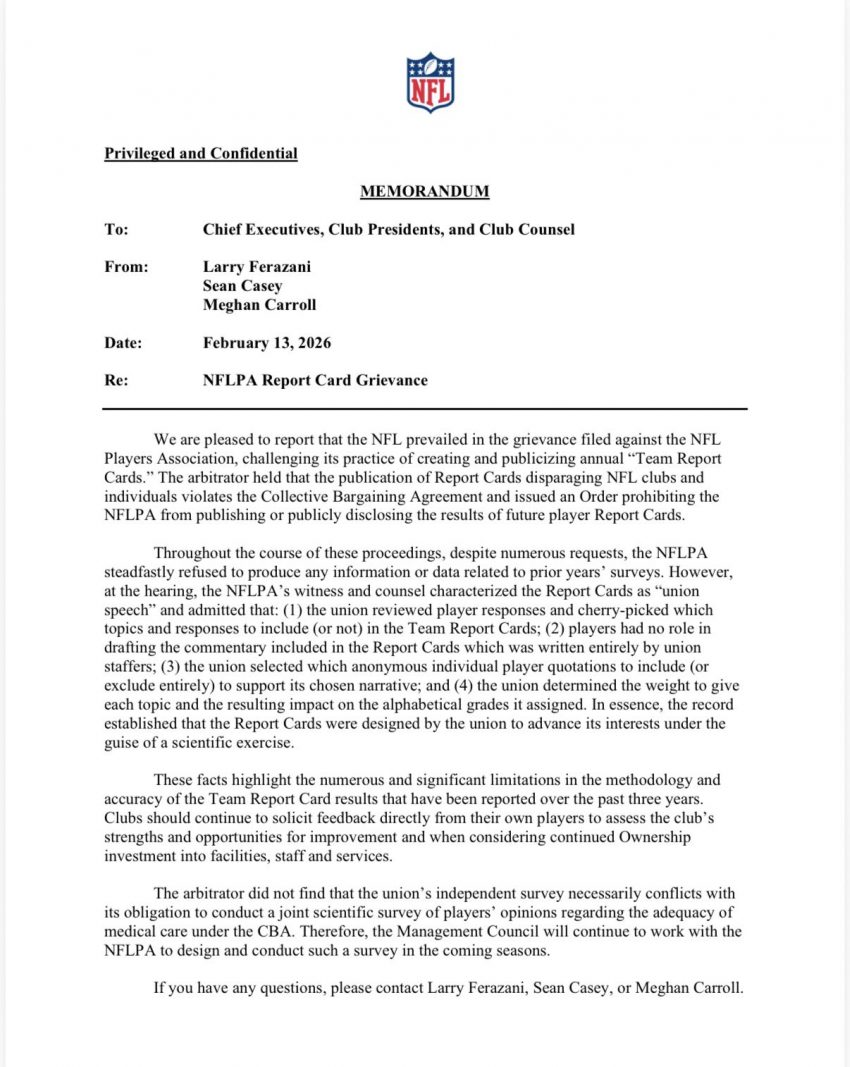
In the official memorandum dated February 13, 2026, the NFL Management Council announced that:
- The arbitrator found the publication of report cards disparaging to clubs and individual owners.
- The NFLPA was ordered to cease publishing or publicly disclosing future player “Team Report Cards.”
- Evidence presented showed union staff selected topics, responses, and weighting criteria.
- Anonymous player quotes were curated to support specific narratives.
The ruling emphasized that the survey process — including topic weighting and grading methodology — was determined solely by the union rather than through collaborative research standards outlined in the CBA.
What the Arbitrator Decided
The arbitrator did not rule that independent surveys are entirely prohibited. Instead, the decision focused on the public dissemination of the report cards and whether they violated collectively bargained standards.
Key findings included:
- The report cards were characterized as “union speech.”
- The union determined which responses to include or exclude.
- Players did not draft the commentary accompanying the grades.
- The methodology and weighting system were not jointly developed with the league.
However, the arbitrator did clarify that independent surveys regarding medical care do not inherently conflict with the CBA, provided they align with agreed-upon joint research requirements. As a result, the NFL Management Council indicated it will continue working with the NFLPA on collaborative surveys concerning medical services.
Impact on Transparency and Player Advocacy
The annual report cards had become a widely cited transparency tool, influencing public perception of franchise culture, training facilities, and ownership investment. Several teams made facility upgrades and operational changes after receiving poor grades in previous reports.
With the ban on public dissemination, players lose a visible accountability mechanism that had generated league-wide discussion. Critics argue that this limits transparency for fans and media, while supporters of the ruling say it ensures fairness and adherence to the CBA.
The decision also highlights ongoing labor tensions despite record-high investments under the current CBA, including expanded benefits, improved facilities, and enhanced player services across franchises.
What This Means for the NFL and NFLPA Moving Forward
The ruling does not end collaboration between the league and the union. Instead, it reinforces that research impacting public evaluation of clubs must comply with jointly negotiated standards.
Going forward:
- The NFLPA may still gather player feedback internally.
- Public grading systems based on unilateral surveys are prohibited.
- Joint surveys, particularly on medical care and player safety, remain permitted under CBA guidelines.
As labor dynamics evolve, this case underscores the balance between player advocacy, organizational transparency, and collectively bargained procedures.
Final Thoughts
The NFL’s victory in the grievance against the NFLPA represents more than a procedural win — it reshapes how player feedback can be publicly shared. While the ban curbs a prominent transparency mechanism, it preserves the framework for collaborative evaluation under the CBA.
With continued investments in facilities and player resources across the league, future discussions between the NFL and NFLPA will likely focus on refining joint research standards rather than eliminating player input altogether.
For now, the era of publicly released NFLPA “Team Report Cards” appears to be on hold.