





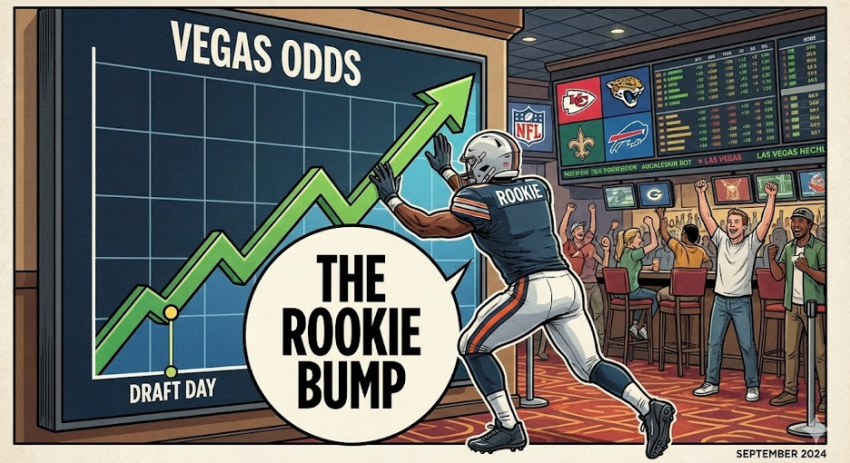
The transition of College football to the NFL every spring brings a clash between two different economic powers: the narrative-driven optimism of fans and the risk-averse, mathematically inflexible structure of sportsbooks. This is referred to as the Rookie Bump in the industry and is a market anomaly where the entry of a star prospect fundamentally changes the valuation of a franchise in the futures market.
To the average fan, the NFL Draft is a season of hope. To the sports bettor, it is a topology of recognizable inefficiencies. Analysis of betting data during the 2020-2024 seasons shows that the hype around high-profile draft picks has always triggered a reduction in Super Bowl odds and an overstatement of win totals that is often not related to historical efficiency measures.
This article breaks down what is happening in the mechanics of the Rookie Bump and how the bookmakers are able to control the public liability, and how the disciplined investor can make a profit by fading the noise.
The Economics of Hope: Why Lines Move
The sports betting market is usually mistaken for a predictive engine. It is, in fact, a liability marketplace. These odds that you are viewing, like the +4500 on the Chicago Bears to win the Super Bowl, are not simply a calculation of probability; they are a risk exposure.
The Mechanism of the “Bump”
With a franchise choosing a player dubbed as a generational one, the market response is instantaneous; a term that has been loosely applied to players such as Trevor Lawrence or Caleb Williams. This phase is usually a three-phase cycle:
- The Pre-Draft Baseline: Oddsmakers place a threshold pegged on the past seasons, such as EPA/play and roster construction. This is historically low in the case of teams that are first in the overall pick.
- The Narrative Injection: The selection of a star is some sort of catalyst. The media attention shifts away from the structural shortcomings of the team to the collegiate superiority of the rookie.
- The Liability Shift: Futures wagers are flooded into the market by recreational betters who are hoping to have some fun and win money. In order to cope with this unidirectional flow, bookmakers adjust the odds downwards (e.g., turning +4500 to +3000), effectively taxing the optimism of those betters who come in late.
The movement is not often a transfer of the shift of the pure Power Rating of the team. A quarterback with a limited record in the past fails to boost the real rating of a team more than 0.5 points as a rookie. The reason why the line moves is due to the fact that the bookmaker has to respect the amount of money, not only the quality of the player.
Public Money vs. Sharp Money
The Rookie Bump is inspired by public money almost entirely. Professional (sharp) bettors do not often commit 10 months of capital on a long-shot future that is being fueled by a rookie. They know that there is a price and a tax on hype.
The bookmakers are aware that demand for such bets is inelastic. The fan who believes that Marvin Harrison Jr. is the next Jerry Rice will be willing to bet the over on his total yards regardless of the line being 800.5 or 950.5. Therefore, lines tend to be stipulated to the “Over” or the “Favorite”, making the public incur a premium on their hope.
Case Study: The Quarterback Premium
The NFL is a quarterback-dominated ecosystem, and no role produces a more violent response in future prices. The last few years have given plenty of examples of how the market overrates rookie signal-callers.
Caleb Williams and the 2024 Chicago Bears
The 2024 Bears were an ideal case of the Rookie Bump. The story was ideal: an old brand, a so-called generational talent in Caleb Williams, and a restructured receiver group.
| Market | Pre-Draft Odds | Post-Draft Odds | Implied Probability Shift |
| Super Bowl Winner | +4500 | +3000 | 2.2% -> 3.2% |
| Win Total | 7.5 (Est.) | 8.5 (Over -149) | Significant “Juice” Added |
| To Make Playoffs | +140 | -110 | 41.6% -> 52.4% |
Table 1: The market priced the Bears as a coin-flip playoff team solely on rookie potential, ignoring historical data regarding rookie sack rates and processing speed.
The “Stroud Effect” and Recency Bias
The great performance of C.J. Stroud in 2023 served as an inflammable gasoline. Stroud contravened all the tendencies in the history of the game and guided a projected 6.5-win team by the Texans to a playoff victory. This aberration had Recency Bias in the 2024 market.
Bettors supposed, “Stroud could do it, Williams could do it. Bookmakers, who are afraid of another black swan event, would not take long odds on the 2024 class. This formed a Stroud Tax where bettors paid a bet that they did not have to pay Stroud the year before, which they paid on Caleb Williams and Jayden Daniels.
Trevor Lawrence: The Cautionary Tale
The 2021 Tank for Trevor campaign made the general public believe that Lawrence assured competence. The number of wins by the Jaguars was inflated to 6.5, with the team having a 1-15 season before. The result? Three wins. The market had overvalued the ceiling of Lawrence just as it undervalued the floor, and it had not taken into consideration the organizational dysfunction surrounding him.
The Skill Position Tax: Fantasy Football’s Impact
Although team futures run on quarterbacks, the roster of players prop the number of markets is on the Skill Position, rookies, Wide Receivers, and Running Backs. The nature of Fantasy Football and Best Ball leagues gives a direct pipeline between the Average Draft Position (ADP) and Vegas lines.
The “Shiny Toy” Syndrome
In betting, behavioral economics emphasizes that the mystery box is better than the known commodity.
- Veteran Fatigue: Bettors are aware of what Mike Evans is offering. There is little “dream equity” in betting his Over.
- Rookie Allure: A newcomer such as Malik Nabers is a symbol of unlimited potential.
This causes the bookmakers to shade rookie props upwards. When a neutral model forecasts 750 yards, the line may be given by the book as 825.5 just because the Over money is sure. Smart money plays to this by finding out the rookies who have some structural issues like traffic in the depth charts or bad QB performance and exploiting the Unders.
The Correlation of Commerce and Liability
Jersey sales in the digital age are a good predictor of betting liability. Merchandising Velocity of a player is a good predictor of where the dumb money will go.
- Caleb Williams (2024): Second in the rookie jersey sales; the Bears experienced huge futures shortening.
- Shedeur Sanders (Projected 2025): Already leading sales lists before snapping in the NFL.
These lists help bookmakers to single out public dogs. When a player makes high sales with jerseys, the book is aware that people will support his team every week. They can manipulate the spread (e.g., +3.5 to +3), so that they can also make the people accept a worse number to support their player of choice.
Strategic Analysis: How to Bet Against the Bump
To the serious sports bettor, the Rookie Bump is a tide to ride with, but a market in efficiency to take advantage of.
1. The “Week 1-4 Fade” Strategy
The betting patterns of the past show that it is lucrative to bet against teams whose popularity is the highest during the first month (due to the hype of rookies).
- The Data: In recent samples, teams that have received more than 60 percent of popular bets in the first four weeks have only a cover rate of about 32 percent.
- The Logic: The market values the team based on its estimated competence after the end of the season. As a matter of fact, September football as a rookie is a struggle to survive.
2. Betting the “Under” on Win Totals
The Season Win Total Under is the most mathematically correct.
- Asymmetrical Risk: To have an overhit on an inflated total (as for the Bears 8.5), virtually all the variables have to break in a positive way. All that is needed to get the Under is casual regression, injury, or normal rookie bad times.
- Timing: These bets should be made in late August, when training camp hype (“He looks great in 7-on-7s!”) is at its highest point.
3. Exploiting “Quiet Value”
The Rookie Bump is an offensive phenomenon. Defensive beginners, even the elite, do not shift the win counts. Teams that significantly overdraft on the defensive and offensive line tend to be better on the Expected Value (EV) of the Over since they are creating infrastructure as opposed to headlines.
Future Outlook: The Shedeur Sanders Horizon
With the NBA 2025 NFL Draft underway, the ecosystem is preparing for the biggest Rookie Bump in history around Shedeur Sanders.
Be it the “Prime Effect” (the marketing machine of Deion Sanders) or huge sales of the jerseys, either way, as many as a player manages to draft Sanders, this will automatically cut their Super Bowl chances in half. Such a gap between the story and the actuality of a rookie QB on a rebuilding roster will probably become the one-time greatest Fade of the decade. Sharps will be prepared to hammer the “Under,” hoping that the market has already discounted a fairytale, and not a football season.