





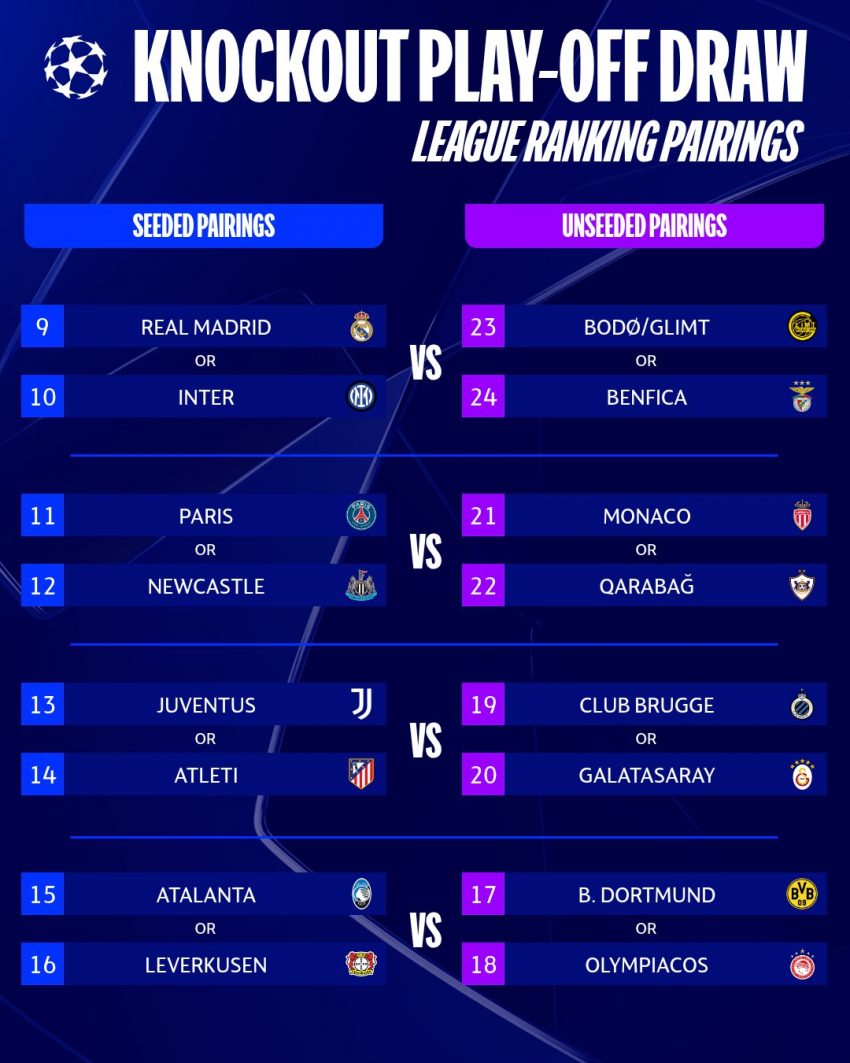
The UEFA Champions League Knockout Playoffs under the new 36-team format are decided by a draw, but it is not a traditional open lottery.
Instead, UEFA uses a structured, seeded draw system that limits which teams can face each other based on their final league phase positions. This approach rewards higher finishes while still preserving an element of randomness.
Below is a full breakdown of how the Champions League knockout playoff draw works and what is — and is not — decided by chance.
How the Champions League Knockout Playoff Draw Works
After the league phase concludes:
- Teams finishing 9th–16th are seeded
- Teams finishing 17th–24th are unseeded
- Seeded teams are paired with unseeded teams in a two-leg playoff
However, each seeded team does not face all possible unseeded teams.
League Ranking Pairings (Fixed Structure)
UEFA pre-assigns pairing lanes based on final standings:
| Seeded Positions | Possible Opponents |
|---|---|
| 9th or 10th | 23rd or 24th |
| 11th or 12th | 21st or 22nd |
| 13th or 14th | 19th or 20th |
| 15th or 16th | 17th or 18th |
Example Matchups
- Real Madrid (9th) or Inter (10th) can only face Bodø/Glimt (23rd) or Benfica (24th)
- Paris Saint-Germain (11th) or Newcastle (12th) can only face Monaco (21st) or Qarabag (22nd)
These restrictions ensure that higher-ranked teams receive a competitive advantage.
What Is Random in the Draw
While the structure is fixed, there is still randomness involved:
- Which of the two eligible opponents a team draws
- In some cases, which team hosts the first leg of the tie
This is why UEFA still conducts a formal draw ceremony.
What Is Not Random
- Teams cannot face any club outside their pairing lane
- There is no open or free-form lottery
- League phase ranking directly determines opponent range
In short, performance in the league phase heavily shapes the knockout path.
Why UEFA Uses This System
UEFA introduced the structured playoff draw to:
- Reward consistency over eight league-phase matches
- Reduce luck-based elimination
- Increase the importance of finishing position
- Create competitive balance while keeping suspense
This system replaces the traditional group-winner vs runner-up format used in previous Champions League editions.
What Happens After the Knockout Playoffs
- Playoff winners advance to the Round of 16
- The Round of 16 draw follows a separate process
- From that point on, the competition transitions to a more traditional knockout bracket
The Champions League final is scheduled for May 30, 2026.
Conclusion: Is It a Lottery?
There is a draw, but it is not a full lottery.
The Champions League knockout playoff draw is best described as a controlled or structured draw, where randomness exists only within strict league-ranking boundaries.