




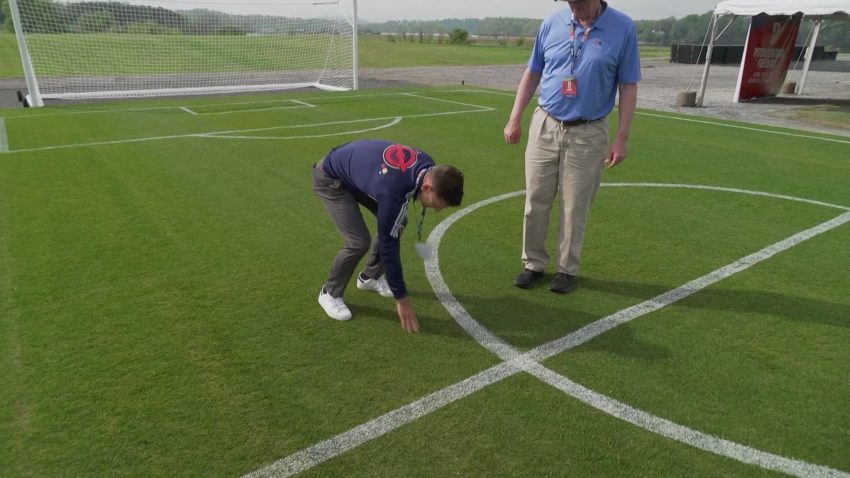
The 2026 FIFA World Cup is not only making history as the first tournament hosted by three countries — the United States, Canada, and Mexico — but it is also drawing attention for the advanced playing surfaces being installed across stadiums.
One of the biggest talking points ahead of the tournament has been the grass itself. FIFA has gone to great lengths to ensure every venue features world-class natural playing surfaces, even in stadiums that normally use artificial turf for NFL games.
What Type of Grass Will Be Used at the 2026 FIFA World Cup?
For the 2026 FIFA World Cup, FIFA is primarily using hybrid natural grass systems. These surfaces are made up of approximately 90 to 95 percent natural grass combined with synthetic reinforcement fibers woven into the pitch to improve durability and consistency.
The hybrid system helps maintain elite playing conditions throughout the tournament while also reducing wear and tear from multiple matches.
Where Does the World Cup Grass Come From?
The grass is being sourced from several specialized turf farms across North America. Different stadiums will use different grass blends depending on climate conditions and whether the venue is indoor or outdoor.
Some of the known turf sources include:
- Tuckahoe Turf Farms in New Jersey
- Turf farms in Colorado
- Additional specialty growers throughout the United States and Canada
Cooler-climate venues are expected to use Kentucky bluegrass and perennial ryegrass blends, while warmer cities will rely more heavily on Bermudagrass.
Why FIFA Is Replacing Artificial Turf
Several stadiums hosting World Cup matches normally use artificial turf during the NFL season. However, FIFA regulations require natural grass surfaces for World Cup matches.
As a result, venues across the U.S. and Canada are temporarily removing turf and installing specially engineered natural grass systems for the tournament.
This has already been tested during Copa América matches and other international soccer events leading into the 2026 World Cup.
FIFA’s Advanced Pitch Technology
FIFA has partnered with turfgrass experts from universities such as the University of Tennessee and Michigan State University to help develop consistent playing surfaces across all 16 host stadiums.
The goal is to create uniform ball movement, player traction, and field conditions regardless of weather or stadium type.
The playing surfaces are expected to be among the most technologically advanced pitches ever used in a FIFA World Cup.
Why the Grass Matters
Pitch quality can significantly impact player performance, ball speed, injuries, and overall match quality. With many of the 2026 World Cup stadiums originally designed for American football, FIFA has made grass installation a top priority.
Players, coaches, and fans alike will be watching closely to see how the hybrid grass performs throughout the tournament.
As the 2026 FIFA World Cup approaches, the carefully engineered natural grass fields are becoming just as much a part of the spectacle as the matches themselves.