




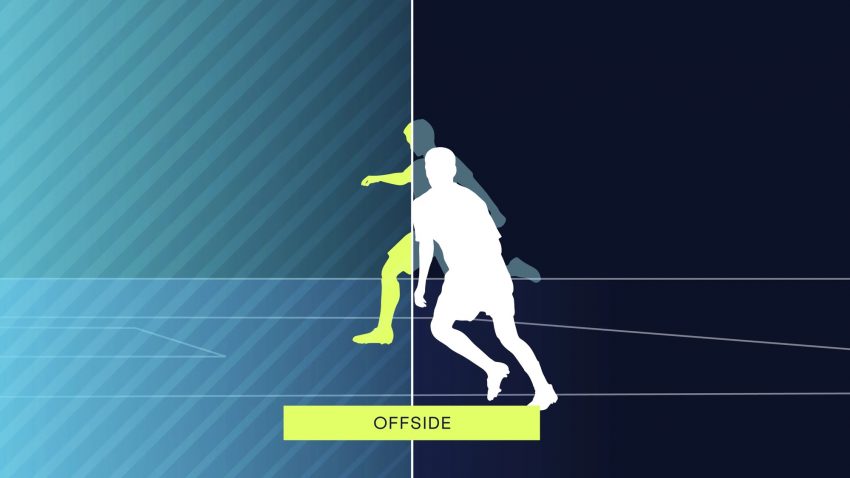
If you’re new to soccer, few rules create more confusion than the offside rule. Fans often see a goal scored only for the assistant referee to raise the flag, leaving everyone wondering what happened.
So, what is offside in soccer? In simple terms, a player is offside if they gain an unfair advantage by being too far ahead of the defense when a teammate passes the ball.
Here’s everything you need to know about how the offside rule works.
What Is Offside in Soccer?
A player is in an offside position if all of the following are true at the moment a teammate plays or touches the ball:
- They are in the opponent’s half of the field.
- Any part of their head, body, or feet that can legally score a goal is nearer to the opponent’s goal line than both:
- the ball, and
- the second-to-last defender (usually the last outfield defender, since the goalkeeper is often the final defender).
However, being in an offside position alone is not an offense.
A player is only penalized if they become actively involved in the play.
When Is a Player Actually Offside?
A player is called offside if they:
- Receive the ball after being in an offside position.
- Interfere with an opponent.
- Block an opponent’s line of sight.
- Challenge an opponent for the ball.
- Gain an advantage from a rebound or deflection while in an offside position.
If none of these occur, play continues.
When Is There No Offside?
Several situations cannot result in an offside offense.
A player is onside if:
- They are level with the second-to-last defender.
- They are level with the ball.
- They are behind the ball when it is passed.
- They are still in their own half of the field.
There Is No Offside From These Restarts
Players cannot be offside directly from:
- Goal kicks
- Throw-ins
- Corner kicks
These exceptions often lead to attacking opportunities.
Why Does Soccer Have an Offside Rule?
The offside rule exists to:
- Prevent attackers from waiting near the opponent’s goal.
- Encourage teamwork and passing.
- Keep the game balanced between attackers and defenders.
- Reward smart movement instead of simply standing behind the defense.
Without the rule, attackers could remain near the goal throughout the match, dramatically changing how soccer is played.
How VAR Determines Offside
At many professional competitions, including major international tournaments and top domestic leagues, Video Assistant Referee (VAR) reviews close offside decisions.
VAR uses technology to:
- Determine the exact moment the ball is played.
- Draw virtual offside lines.
- Identify the position of every relevant player.
- Confirm whether any scoring body part is beyond the second-to-last defender.
Even extremely close decisions can result in an offside call if any legal scoring body part is ahead at the moment the pass is made.
Common Misconceptions About Offside
Myth: The goalkeeper is always the last defender.
Not necessarily. The rule refers to the second-to-last defender, which could include or exclude the goalkeeper depending on where everyone is positioned.
Myth: Any body part counts.
Only body parts that can legally score a goal count. Arms and hands are ignored because players cannot score with them.
Myth: The player is judged when they receive the ball.
The player’s position is judged when the teammate plays the pass, not when they collect it.
Myth: Level means offside.
Being exactly level with the second-to-last defender is considered onside.
Example of an Offside Play
Imagine this situation:
- A striker runs behind the defensive line.
- A midfielder passes the ball forward.
- At the instant the pass is made, the striker is closer to the goal than the second-to-last defender.
- The striker receives the pass and scores.
Because the striker was in an offside position when the pass was played and became involved in the attack, the goal is disallowed.
Why Fans Often Disagree With Offside Calls
Offside decisions happen in fractions of a second. Human eyes can struggle to judge:
- The exact timing of the pass.
- The precise position of attackers and defenders.
- Whether a player interfered with play.
That’s why close decisions are frequently reviewed using VAR in major competitions.
Frequently Asked Questions
Can you be offside if you’re behind the ball?
No. A player who is behind the ball when it is played cannot be offside.
Can you be offside in your own half?
No. A player must be in the opponent’s half of the field to be in an offside position.
Is being level with the defender offside?
No. Being level with the second-to-last defender is considered onside.
Can a player be offside from a corner kick?
No. There is no offside offense directly from a corner kick.
Why is it called the second-to-last defender?
The goalkeeper is usually the last defender, so the rule measures attackers against the second-to-last defender. However, if the goalkeeper has moved forward, another defender may become the last defender instead.
Final Thoughts
The offside rule is designed to keep soccer fair by preventing attackers from gaining an unfair positional advantage. While it can seem confusing at first, the basic principle is straightforward: a player cannot receive a forward pass from a teammate while positioned beyond both the ball and the second-to-last defender unless one of the rule’s exceptions applies.
Once you understand that **the player’s position is judged at the moment the pass is made—not when the ball is received—**the offside rule becomes much easier to follow. Whether you’re watching your first match or a championship final, knowing how offside works will help you better understand one of soccer’s most important and frequently debated rules.