





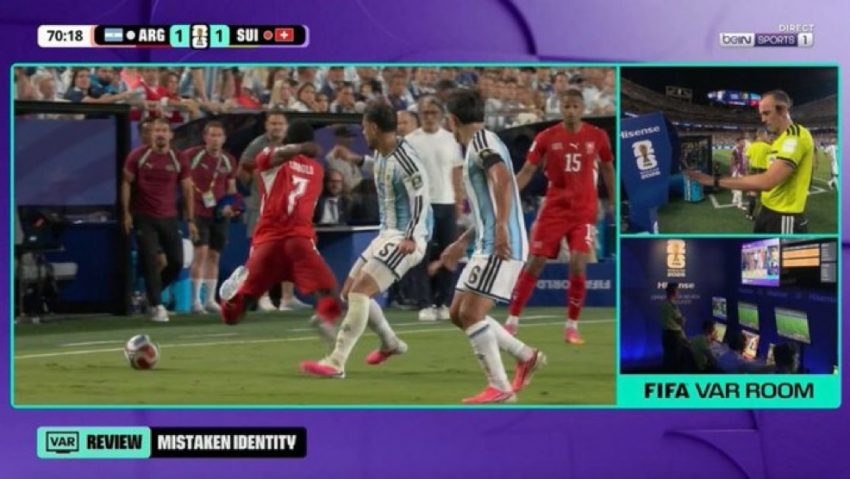
Simulation, more commonly known as diving, is one of the most controversial offenses in soccer. During the 2026 FIFA World Cup, players can receive a yellow card for simulation if they attempt to deceive the referee into awarding a foul, free kick, or penalty kick.
With the tournament introducing expanded use of VAR (Video Assistant Referee) to correct certain disciplinary decisions, simulation has become an even bigger talking point throughout the competition.
What Is Simulation in Soccer?
Under IFAB’s Law 12 (Fouls and Misconduct), simulation is considered unsporting behavior.
A player is guilty of simulation when they deliberately try to fool the referee by making it appear that they were fouled when they were not, or by significantly exaggerating contact to gain an advantage.
Examples include:
- Falling to the ground without being fouled.
- Pretending to be tripped or pushed.
- Exaggerating minimal contact in hopes of winning a penalty kick.
- Faking or overstating an injury to influence the referee.
If the referee determines a player has simulated, they will stop play (if appropriate) and issue a yellow card for unsporting behavior.
What Happens After a Yellow Card for Simulation?
A single yellow card does not result in a player being sent off.
However:
- The player remains in the match after receiving the caution.
- A second yellow card in the same game results in a red card and immediate dismissal.
- Yellow cards can also accumulate during the FIFA World Cup, potentially leading to suspension depending on the stage of the tournament.
How VAR Handles Simulation at the 2026 FIFA World Cup
One of the notable officiating changes at the 2026 FIFA World Cup is the limited expansion of VAR’s authority involving simulation.
If a referee mistakenly cautions a defender for committing a foul, but video review clearly shows the attacker actually simulated the incident, VAR can recommend an on-field review.
Following the review, the referee may:
- Cancel the yellow card shown to the defender.
- Issue a yellow card to the attacking player for simulation.
- Restart play according to the Laws of the Game.
This protocol is designed to ensure that the correct player is disciplined while discouraging attempts to deceive officials.
High-Profile Example: Argentina vs. Switzerland
One of the most talked-about examples occurred during the 2026 FIFA World Cup quarterfinal between Argentina and Switzerland.
Argentina midfielder Leandro Paredes was initially booked for allegedly fouling Swiss forward Breel Embolo. After a VAR review, referee João Pinheiro determined that Embolo had simulated the foul.
The decision resulted in:
- Paredes’ yellow card being rescinded.
- Embolo receiving a yellow card for simulation.
- Embolo being shown a red card because it was his second caution of the match.
The incident quickly became one of the tournament’s most debated VAR decisions and highlighted FIFA’s updated approach to dealing with simulation.
Why FIFA Punishes Simulation
Simulation undermines the fairness of the game by attempting to deceive match officials and gain an unfair advantage.
By issuing yellow cards for diving—and allowing VAR to correct certain mistaken cautions—FIFA aims to:
- Protect the integrity of matches.
- Discourage players from exaggerating contact.
- Ensure disciplinary actions are applied to the correct player.
- Improve officiating accuracy through video review.
FAQ
What is simulation in soccer?
Simulation, often called diving, occurs when a player deliberately attempts to deceive the referee into believing they were fouled or exaggerates contact to gain a favorable decision.
Is simulation always a yellow card?
Yes. Under the Laws of the Game, simulation is considered unsporting behavior and is punishable by a yellow card.
Can VAR overturn a simulation decision?
VAR cannot review every yellow card. However, at the 2026 FIFA World Cup, it can intervene in specific situations where a player was incorrectly cautioned for a foul and video evidence clearly shows the opponent simulated the incident.
Can a player be sent off for simulation?
Yes. If a player who has already been cautioned receives a second yellow card for simulation, they are shown a red card and are sent off.
Final Thoughts
A yellow card for simulation remains one of soccer’s key disciplinary measures against players who attempt to deceive officials. At the 2026 FIFA World Cup, FIFA’s updated VAR protocol has placed even greater emphasis on identifying diving and ensuring that the correct player receives disciplinary action.
The Argentina vs. Switzerland quarterfinal demonstrated how quickly a simulation decision can change the course of a match, reinforcing FIFA’s commitment to using technology to improve the accuracy and fairness of officiating.