





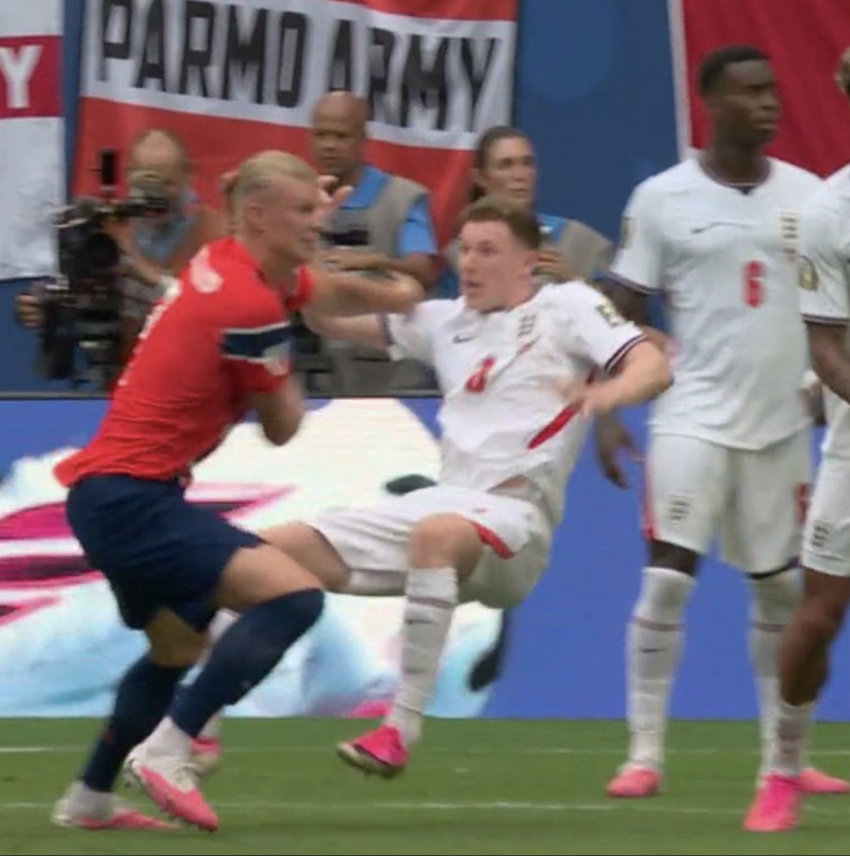
Norway thought it had taken a crucial second-half lead against England in the 2026 FIFA World Cup quarterfinal, only for the goal to be ruled out after a Video Assistant Referee (VAR) review.
The decision became one of the biggest talking points of the match, as referee Clément Turpin overturned the goal after reviewing an incident in the buildup.
Why Was Norway’s Goal Disallowed?
Norway appeared to score from a corner kick to move ahead 2-1, but play was halted while VAR reviewed the sequence leading up to the goal.
The review focused on Erling Haaland’s challenge on England midfielder Elliot Anderson inside the penalty area before the ball crossed the goal line.
After watching the replay on the pitchside monitor, Turpin determined that Haaland had committed a foul by pushing and holding Anderson, preventing the England player from competing fairly for the ball.
As a result, the goal was disallowed and England was awarded a defensive free kick.
What Did VAR Review?
Under FIFA’s VAR protocol, officials can review the attacking phase leading directly to a goal for potential offenses, including:
- Fouls by attacking players
- Handballs
- Offside infractions
- Other violations that directly lead to a goal
In this case, VAR concluded that Haaland’s contact with Anderson occurred during the attacking buildup and had a direct impact on the scoring play.
Why the Referee Changed the Decision
Initially, the goal was awarded on the field.
However, after being advised by the VAR officials to conduct an on-field review, Turpin watched multiple replay angles before overturning his original decision.
The referee judged that Haaland’s actions illegally impeded Anderson from challenging for the ball, meaning the attacking team had committed a foul before the goal was scored.
Why the Decision Was Controversial
The overturned goal immediately sparked debate among fans and analysts.
Some argued the physical contact was typical of set-piece battles inside the penalty area and should not have warranted a foul. Others believed the amount of holding and pushing clearly prevented Anderson from making a legitimate attempt to defend the cross.
Because the referee reviewed the incident personally on the pitchside monitor before making the final call, the decision remained with the on-field official rather than VAR itself.
FIFA VAR Rules on Goals
According to the Laws of the Game, VAR is allowed to intervene whenever there is evidence of:
- A foul committed by the attacking team in the buildup to a goal.
- An offside offense.
- A handball offense by the attacking team.
- Mistaken identity or other reviewable incidents directly related to the goal.
If the referee determines an attacking foul occurred before the ball entered the net, the goal must be disallowed.
Final Takeaway
Norway’s apparent second goal against England at the 2026 FIFA World Cup was ruled out because referee Clément Turpin determined, following a VAR review, that Erling Haaland fouled Elliot Anderson in the buildup. Although Norway celebrated what appeared to be a go-ahead goal, the review found that the attacking foul directly affected the play, resulting in the goal being overturned and England receiving a free kick instead.