





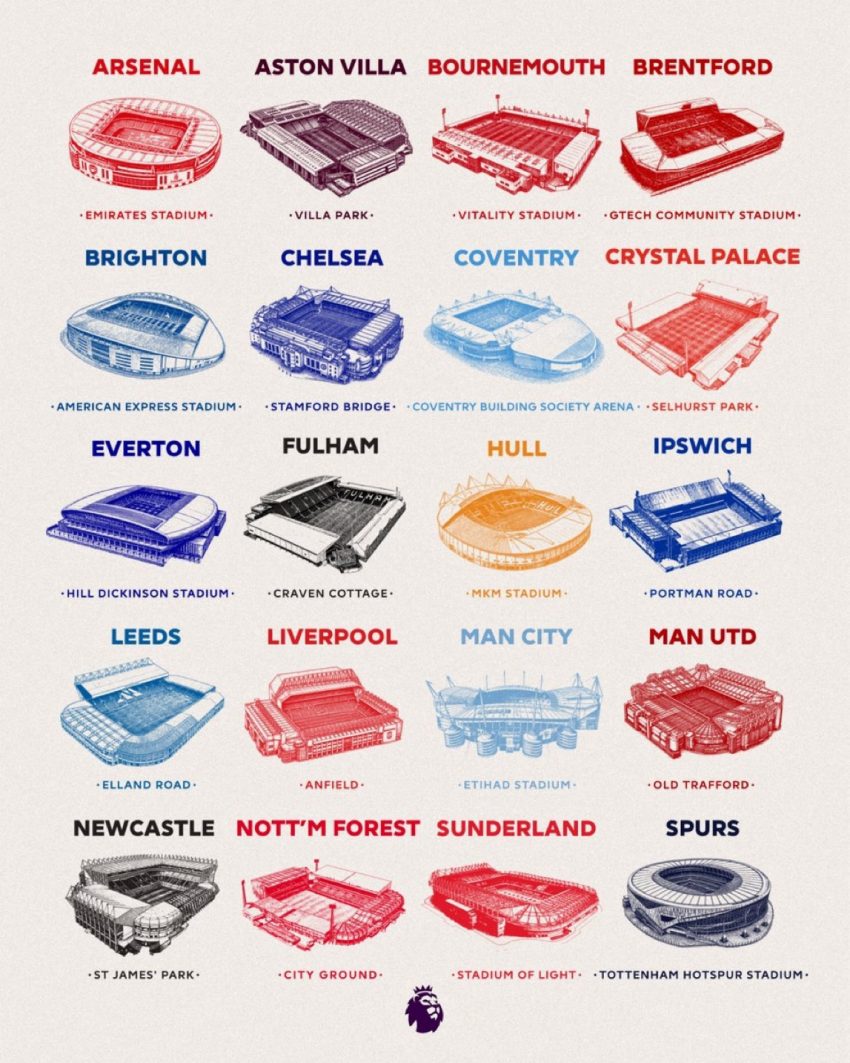
The 2026/27 Premier League season features 20 clubs playing across some of the most famous football stadiums in England, from Manchester United’s historic Old Trafford and Liverpool’s Anfield to modern venues such as Tottenham Hotspur Stadium and Everton’s Hill Dickinson Stadium.
The stadium lineup also changes following promotion and relegation.
Coventry City, Ipswich Town and Hull City were promoted to the Premier League for 2026/27, replacing Wolverhampton Wanderers, Burnley and West Ham United.
That means the Coventry Building Society Arena, Portman Road and MKM Stadium are part of the Premier League stadium map this season.
Here is the complete list of Premier League clubs and their stadiums for the 2026/27 season.
Premier League Stadiums 2026/27
| Premier League Club | Stadium |
|---|---|
| Arsenal | Emirates Stadium |
| Aston Villa | Villa Park |
| Bournemouth | Vitality Stadium |
| Brentford | Gtech Community Stadium |
| Brighton & Hove Albion | American Express Stadium |
| Chelsea | Stamford Bridge |
| Coventry City | Coventry Building Society Arena |
| Crystal Palace | Selhurst Park |
| Everton | Hill Dickinson Stadium |
| Fulham | Craven Cottage |
| Hull City | MKM Stadium |
| Ipswich Town | Portman Road |
| Leeds United | Elland Road |
| Liverpool | Anfield |
| Manchester City | Etihad Stadium |
| Manchester United | Old Trafford |
| Newcastle United | St James’ Park |
| Nottingham Forest | City Ground |
| Sunderland | Stadium of Light |
| Tottenham Hotspur | Tottenham Hotspur Stadium |
Arsenal — Emirates Stadium
Arsenal play their home matches at Emirates Stadium in North London.
Opened in 2006 as the replacement for Arsenal’s historic Highbury ground, the Emirates has become one of the Premier League’s most recognizable modern stadiums.
Arsenal enter the 2026/27 campaign as the reigning Premier League champions.
Aston Villa — Villa Park
Aston Villa play at Villa Park in Birmingham.
Villa Park is one of English football’s classic grounds and has been Aston Villa’s home since 1897.
Its traditional four-stand design and long history make it one of the most distinctive venues remaining in the Premier League.
Bournemouth — Vitality Stadium
Bournemouth play at Vitality Stadium, traditionally known as Dean Court.
The stadium is considerably smaller than most Premier League grounds, creating an intimate atmosphere with supporters positioned close to the pitch.
Brentford — Gtech Community Stadium
Brentford play at Gtech Community Stadium in West London.
The stadium opened in 2020 and replaced Griffin Park, which had served as Brentford’s home for more than a century.
Its relatively compact design has helped Brentford maintain the close atmosphere associated with their previous ground.
Brighton & Hove Albion — American Express Stadium
Brighton play at the American Express Stadium, commonly known as the Amex.
Located in Falmer, the stadium opened in 2011 and provided Brighton with a permanent modern home after years without their own dedicated stadium.
Chelsea — Stamford Bridge
Chelsea play their home matches at Stamford Bridge in West London.
Stamford Bridge has been Chelsea’s home since the club was founded in 1905 and remains one of the most famous stadiums in English football.
Despite numerous discussions surrounding redevelopment or expansion, Chelsea continue to call Stamford Bridge home in 2026/27.
Coventry City — Coventry Building Society Arena
Coventry City play at the Coventry Building Society Arena.
The stadium returns to the Premier League stage after Coventry earned promotion for the 2026/27 season.
Coventry won the Championship title to secure their return to England’s top flight for the first time since the 2000/01 season.
That makes the Coventry Building Society Arena one of the newest additions to the Premier League stadium lineup.
Crystal Palace — Selhurst Park
Crystal Palace play at Selhurst Park in South London.
Palace have called the stadium home since 1924.
Selhurst Park is particularly known for its atmosphere, with supporters positioned close to the playing surface.
Everton — Hill Dickinson Stadium
Everton play at Hill Dickinson Stadium at Bramley-Moore Dock in Liverpool.
The modern waterfront stadium replaced Goodison Park as Everton’s home and represents one of the biggest stadium changes in the club’s history.
Everton’s new ground also gives the Premier League another major modern football venue alongside stadiums such as the Emirates, Etihad and Tottenham Hotspur Stadium.
Fulham — Craven Cottage
Fulham play at Craven Cottage alongside the River Thames in London.
Craven Cottage is one of English football’s most distinctive grounds, combining modern redevelopment with historic features.
The stadium has been Fulham’s home since 1896.
Hull City — MKM Stadium
Hull City play at the MKM Stadium in Kingston upon Hull.
Hull earned promotion to the Premier League through the Championship playoffs and return to England’s top division for 2026/27.
The MKM Stadium is a multi-purpose venue shared with rugby league club Hull FC.
Ipswich Town — Portman Road
Ipswich Town play at Portman Road in Suffolk.
Portman Road has been Ipswich’s home since 1884 and returns to the Premier League following the club’s promotion for 2026/27.
Ipswich join Coventry and Hull as the Premier League’s three newly promoted clubs.
Leeds United — Elland Road
Leeds United play at Elland Road in West Yorkshire.
One of the most recognizable traditional football grounds in England, Elland Road has been Leeds United’s home throughout the club’s history.
Its passionate atmosphere makes it one of the Premier League’s most imposing away venues.
Liverpool — Anfield
Liverpool play at Anfield.
Few football stadiums in the world have a reputation comparable to Liverpool’s historic home.
Anfield has undergone significant expansion in recent years while retaining famous features including the Kop.
The stadium remains central to Liverpool’s identity and is one of the Premier League’s most internationally recognizable venues.
Manchester City — Etihad Stadium
Manchester City play at the Etihad Stadium.
Originally built for the 2002 Commonwealth Games, the stadium was converted for football and became Manchester City’s home in 2003.
It has subsequently undergone major development as part of the larger Etihad Campus.
Manchester United — Old Trafford
Manchester United play at Old Trafford.
Nicknamed the “Theatre of Dreams,” Old Trafford is one of the most famous football stadiums in the world.
Manchester United have played there since 1910, although the club has explored major plans concerning the long-term future of its stadium.
For the 2026/27 Premier League season, Old Trafford remains United’s home ground.
Newcastle United — St James’ Park
Newcastle United play at St James’ Park.
Located prominently in central Newcastle, the stadium has been Newcastle United’s home since the club’s formation.
Its large stands and passionate support make St James’ Park one of the most recognizable grounds in the Premier League.
Nottingham Forest — City Ground
Nottingham Forest play at the City Ground, located alongside the River Trent.
Forest have played at the stadium since 1898.
The ground remains closely associated with the club’s history, including the era in which Nottingham Forest became one of Europe’s most successful teams under Brian Clough.
Sunderland — Stadium of Light
Sunderland play at the Stadium of Light.
Opened in 1997 as the replacement for Roker Park, the Stadium of Light is one of the largest football grounds in England outside the traditional Premier League giants.
Sunderland retained their Premier League status after returning to the top flight for the 2025/26 campaign.
Tottenham Hotspur — Tottenham Hotspur Stadium
Tottenham Hotspur play at Tottenham Hotspur Stadium in North London.
Opened in 2019 on the site of Tottenham’s former White Hart Lane ground, the stadium is one of the most technologically advanced football venues in the world.
Its retractable pitch allows the venue to host NFL games and other major events without requiring Tottenham’s football surface to be used.
Which Premier League Stadiums Are New for 2026/27?
Three stadiums enter the Premier League lineup following promotion from the Championship:
- Coventry Building Society Arena — Coventry City
- MKM Stadium — Hull City
- Portman Road — Ipswich Town
Coventry, Ipswich and Hull became Premier League clubs for the 2026/27 season after the relegation of Wolverhampton Wanderers, Burnley and West Ham United.
Their arrival gives the league a mixture of historic grounds, modern arenas and stadiums returning to Premier League football after lengthy absences.
What Is the Most Famous Premier League Stadium?
There is no official designation for the Premier League’s most famous stadium, but Old Trafford and Anfield are among the league’s most internationally recognizable grounds.
Old Trafford has been Manchester United’s home since 1910, while Anfield is synonymous with Liverpool and its famous Kop.
Other iconic Premier League venues include Arsenal’s Emirates Stadium, Newcastle’s St James’ Park, Aston Villa’s Villa Park and Chelsea’s Stamford Bridge.
How Many Stadiums Are in the Premier League?
There are 20 clubs in the Premier League, with each team having its own designated home ground for league matches.
The Premier League consists of 20 teams playing one another home and away, producing 380 matches across the season.
That means every Premier League stadium hosts matches throughout the campaign as clubs compete for the championship, European qualification and survival.
Premier League Stadiums 2026/27: Full List
The complete lineup of Premier League stadiums for the 2026/27 season is:
Emirates Stadium, Villa Park, Vitality Stadium, Gtech Community Stadium, American Express Stadium, Stamford Bridge, Coventry Building Society Arena, Selhurst Park, Hill Dickinson Stadium, Craven Cottage, MKM Stadium, Portman Road, Elland Road, Anfield, Etihad Stadium, Old Trafford, St James’ Park, City Ground, Stadium of Light and Tottenham Hotspur Stadium.
From historic venues such as Old Trafford, Anfield, Villa Park and Craven Cottage to modern grounds such as Tottenham Hotspur Stadium, Emirates Stadium and Hill Dickinson Stadium, the 2026/27 Premier League features one of the most diverse collections of football stadiums in the world.