




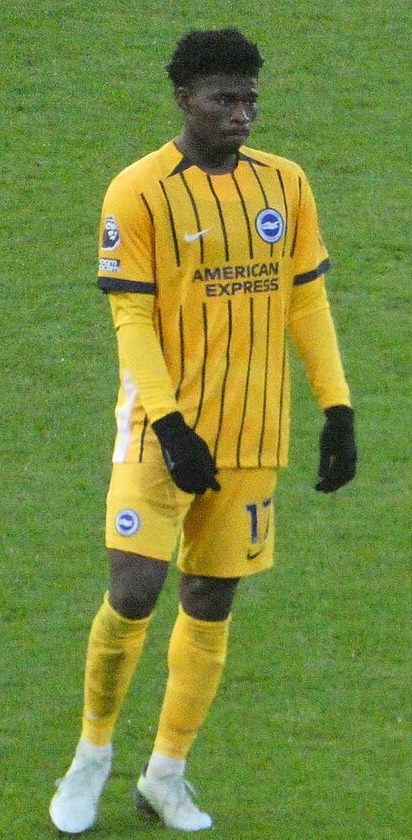
Carlos Baleba has emerged as one of the most exciting young central midfielders in the Premier League. Combining explosive athleticism with aggressive ball-winning and powerful progressive carries, the Cameroon international possesses many of the qualities demanded of a modern defensive midfielder.
After developing at Lille and establishing himself with Brighton & Hove Albion, Baleba has attracted interest from some of Europe’s biggest clubs. But what type of player is he, where is his best position, and what must he improve to reach the highest level?
Carlos Baleba profile
- Full name: Carlos Noom Quomah Baleba
- Date of birth: 3 January 2004
- Place of birth: Douala, Cameroon
- Nationality: Cameroonian
- Height: Approximately 1.79 metres
- Preferred foot: Left
- Position: Defensive midfielder or central midfielder
- International team: Cameroon
Baleba is primarily a central or defensive midfielder, although his skill set does not fit neatly into one traditional role. He can operate as a ball-winning No. 6, a dynamic No. 8 or the more aggressive member of a double pivot.
What is Carlos Baleba’s playing style?
Carlos Baleba’s playing style is based on athletic power, defensive intensity and progressive ball carrying. He is most effective in matches featuring transitions, open spaces and frequent physical contests.
Rather than remaining in front of the defence and controlling possession from a fixed position, Baleba prefers to influence the game dynamically. He steps forward to challenge opponents, covers ground quickly and uses his acceleration to move the ball through midfield.
His ability to recover defensively is particularly valuable. Even when his team loses possession in an exposed position, Baleba has the pace and strength to chase opponents, close passing lanes and compete for the ball.
In possession, he is a direct midfielder. He can receive under pressure, protect the ball with his body and accelerate beyond the first defensive line. These carries help his team escape pressure and turn defensive situations into attacks.
Carlos Baleba’s greatest strengths
Explosive ball carrying
Baleba’s most distinctive quality is his ability to carry the ball through midfield. He combines close control with powerful acceleration, enabling him to escape opponents and break lines without relying on a pass.
This makes him especially dangerous against teams that press aggressively. Once he beats the first opponent, he can create an overload further up the pitch.
Physical strength and athleticism
Baleba is extremely difficult to dispossess when he establishes control of the ball. His upper-body strength helps him protect possession, while his speed enables him to cover large areas of the pitch.
His athleticism also gives coaches tactical flexibility. He can press higher up the field, defend wide spaces or recover when his team’s structure breaks down.
Defensive duelling
Baleba approaches defensive contests with aggression. He is comfortable making tackles, competing for loose balls and confronting opponents directly.
He can overwhelm less physical midfielders and is particularly effective during transition moments, when quick reactions and recovery speed matter more than a settled defensive shape.
Press resistance
Although he is not a conventional deep-lying playmaker, Baleba can receive the ball under pressure. His balance, control and strength allow him to turn away from markers or retain possession until a passing option becomes available.
This is an important quality for teams that build attacks from the back.
Long-range shooting
Baleba can strike the ball with considerable power from outside the penalty area. Goals have not been a major part of his statistical output, but his shooting technique gives defenders another threat to consider when he advances toward the box.
What does Carlos Baleba need to improve?
Positional discipline
Baleba’s aggression can occasionally work against him. He sometimes moves toward the ball too early or follows an opponent into an area that leaves space behind him.
Improved positioning would make him more dependable as a lone defensive midfielder, particularly against teams capable of exploiting spaces between the lines.
Passing consistency
Baleba can play progressive passes, but he is not yet an elite midfield controller. His distribution is generally more functional than creative, and he does not consistently dictate the speed of a match.
Developing greater variety and precision in his passing would make him more effective against compact, deep-defending opponents.
Decision-making in possession
His confidence as a ball carrier can lead him to attempt difficult dribbles in dangerous central areas. At times, releasing the ball earlier would allow his team to progress with less risk.
Knowing when to carry, pass or slow the game down will be central to his development.
Discipline
Baleba’s physical and proactive defensive style can produce unnecessary fouls and yellow cards. Refining his timing would help him maintain his intensity without becoming a disciplinary liability.
Attacking production
Baleba is capable of spectacular moments, but goals and assists have not been a consistent feature of his game. His primary value comes from ball recovery and progression rather than final-third creativity.
If used as a No. 8, he would need to improve his movement around the penalty area and the quality of his final pass.
What is Carlos Baleba’s best position?
Baleba’s best role is currently in a double midfield pivot. This setup allows him to press, carry the ball and defend transitions while a more positionally disciplined partner provides structure.
He can also operate as the defensive midfielder in a 4-3-3, particularly when surrounded by technically secure teammates. However, deploying him as a lone No. 6 places greater responsibility on his positional awareness and ability to control the rhythm of possession.
Baleba is therefore better described as a defensive midfielder with box-to-box qualities than as a purely static holding player.
Which tactics suit Carlos Baleba?
Baleba is particularly well suited to:
- High-intensity pressing systems
- Teams that attack quickly after regaining possession
- Midfields requiring speed and physical coverage
- Build-up structures that encourage midfielders to carry through pressure
- Double-pivot systems pairing him with a composed distributor
A slower possession system could still accommodate him, but it would demand further development in his passing and positional patience.
Carlos Baleba’s career development
Baleba began his development in Cameroon with École de Football des Brasseries du Cameroun. He moved to French club Lille in 2022, where his athleticism and potential quickly attracted attention.
Brighton signed him in August 2023. His first Premier League season included a mixture of starts and substitute appearances as he adapted to the speed and tactical demands of English football.
He subsequently developed into a more prominent midfielder, demonstrating that his physical qualities could translate to one of the world’s most demanding leagues. His performances also earned him senior international recognition with Cameroon.
By the end of the 2025–26 campaign, Baleba had made more than 90 Premier League appearances for Brighton. Reports in August 2026 indicated that Manchester United had agreed a deal worth an initial £65 million, plus £5 million in potential add-ons, although any change of club remained subject to completion and official confirmation at the time of writing.
How good can Carlos Baleba become?
Baleba has the physical tools to become an elite Premier League midfielder. His combination of acceleration, strength, defensive range and ball-carrying ability is difficult to find.
His ultimate level will depend on how effectively he improves the more subtle parts of midfield play: positioning, passing selection, tactical patience and control of match tempo.
If those areas develop, Baleba could become a complete midfielder capable of protecting the defence, breaking pressure and driving his team forward. Even without reaching that ceiling, his athletic qualities make him highly valuable to an aggressive, transition-focused side.
Carlos Baleba player comparison
Baleba’s profile has similarities to powerful Premier League midfielders who combine ball recovery with progressive carrying. Comparisons with Moisés Caicedo are understandable because both players developed at Brighton and possess the athleticism to cover large defensive spaces.
However, Baleba is generally a more explosive and adventurous carrier, while Caicedo has shown greater positional control and passing reliability. Baleba should therefore be evaluated on his own developmental path rather than viewed as a direct replacement or replica.
Final assessment
Carlos Baleba is a high-upside modern midfielder capable of transforming games through physical dominance, defensive intensity and direct ball progression.
He is not yet a finished midfield controller. His positioning, decision-making and passing consistency still require refinement. Nevertheless, players with his combination of power, speed, technical confidence and Premier League experience are rare—especially at his age.
For teams seeking a midfielder who can win duels, escape pressure and dominate transitional phases, Baleba represents an outstanding long-term prospect.
Frequently asked questions
What position does Carlos Baleba play?
Carlos Baleba plays as a defensive or central midfielder. He is most comfortable in a double pivot or as an energetic midfielder in a 4-3-3.
Is Carlos Baleba left-footed?
Yes. Baleba is predominantly left-footed.
Which country does Carlos Baleba represent?
Baleba represents Cameroon at senior international level.
What are Carlos Baleba’s main strengths?
His main strengths are ball carrying, acceleration, physical power, defensive coverage, tackling and press resistance.
What are Carlos Baleba’s weaknesses?
He needs to improve his positional discipline, passing consistency, decision-making and attacking output.
Is Carlos Baleba a No. 6 or a No. 8?
He can perform both roles. At present, he is best characterized as a defensive midfielder with box-to-box qualities, ideally operating alongside a more positionally disciplined partner.